30 April 2026
Learning the Way We Learned to Walk: Without Fear, Without Rush, With All Our Senses
Remember how you learned to talk? No textbooks, no exams, no fear of making mistakes. At After School, we believe the best way to learn is still the same: experience, play, and discover.
Learning the Way We Learned to Walk: Without Fear, Without Rush, With All Our Senses
Think about a baby learning to talk.
Nobody sits them down at a desk to study grammar. Nobody hands them flashcards with irregular verbs. Nobody fails them for conjugating wrong. They simply listen, repeat, make mistakes, try again, and one day — without noticing exactly when it happened — they’re speaking.
Now think about how you learned to walk. You fell dozens of times. Hundreds, probably. And every time you fell, you got back up. Nobody gave you a balance exam. Nobody told you you’d failed. Your body, your brain, and your curiosity did the work together, at their own pace.
That’s how human beings are designed to learn. It’s not an alternative method or a modern theory. It’s the original way — the one we’ve been using for thousands of years, long before classrooms existed.
The question is: what happened between that fearless baby and the adult who panics at the thought of making an English mistake in front of someone?
Somewhere along the way, learning became something else
We’re not pointing fingers. Just observing something you probably recognise.
For many people, “learning” ended up associated with sitting down, memorising, repeating, and being tested. With being right or being wrong. With getting a pass or a fail. And that association, which forms very early, can stay with us for life.
The result is that many adults walk into a language school saying “I’m just really bad at languages”. And it’s not true. What happened is that at some point, learning stopped being something they did with natural curiosity and became something they did with tension and fear of getting it wrong.
But that programming can be changed. Because the natural way of learning doesn’t disappear — it just falls asleep.
Playing is not wasting time
There’s a widespread belief that playing is the opposite of learning. That if you’re having fun, you’re not really working. That serious learning is the kind that hurts, and fun is a reward you get after you’ve suffered enough.
We think the exact opposite.
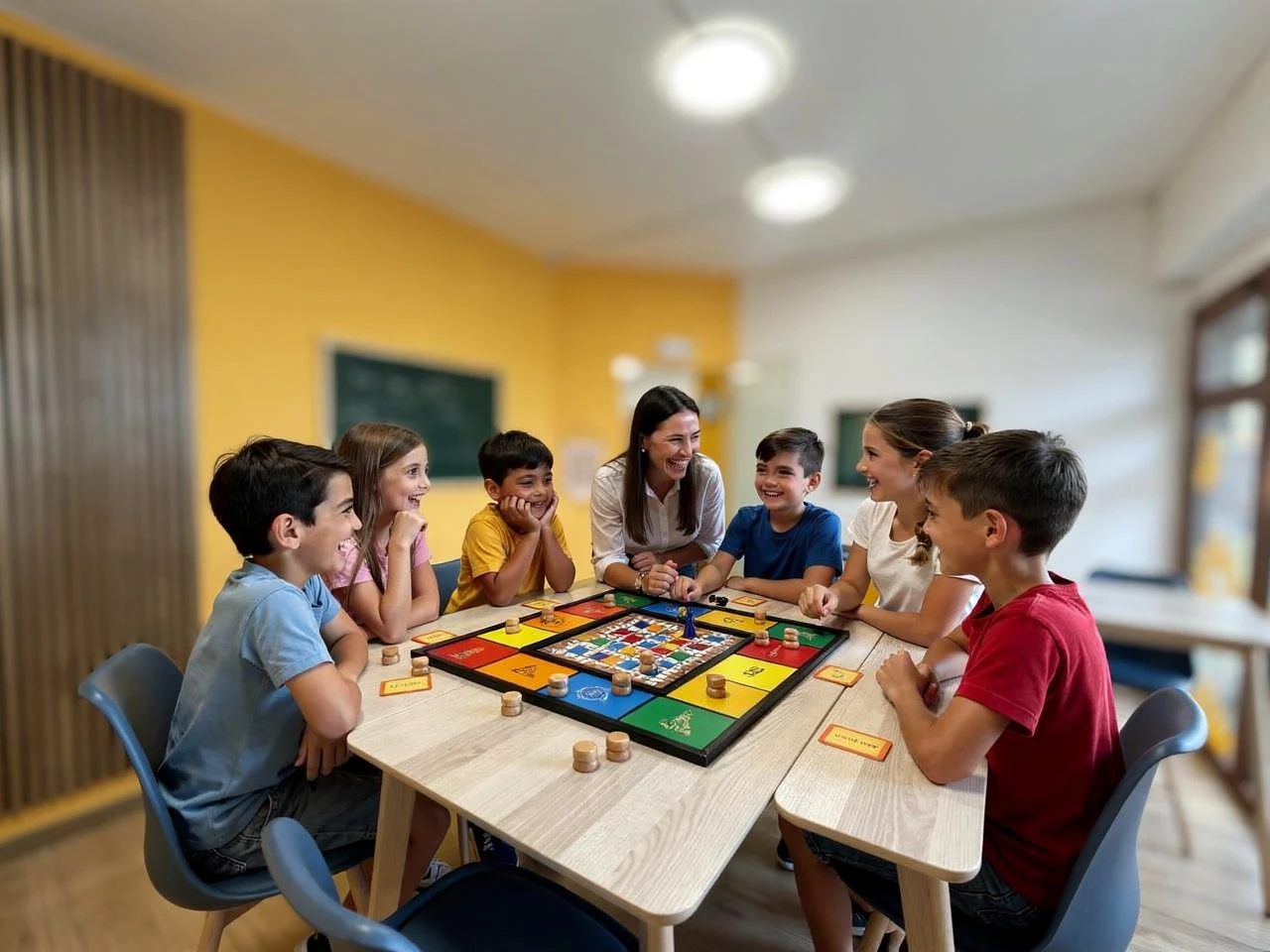
When you play, your defences come down. You’re not afraid of making mistakes because mistakes are part of the game. You’re paying attention because you want to, not because you’re forced to. And what you learn in that state sticks — because your brain associates it with a positive experience, not a threat.
This isn’t just our gut feeling. Neuroscience has spent decades confirming that we learn better when there’s positive emotion, when the environment feels safe, and when we participate actively rather than passively receiving information.
Does that mean everything is an unstructured game? No. It means play is the structure. Behind every activity that looks like “just fun” there’s a clear learning objective. But the student doesn’t experience it as an obligation — they experience it as something they want to do.
Mistakes are the best teacher (if you let them do their job)
Remember the fire? Every parent tells their small child not to touch the fire. And every child, at some point, needs to get close enough to feel the heat. Not out of disobedience — out of curiosity. Because human beings learn from experience, not from warnings.
With languages — and with almost any skill — it’s the same.
You can memorise that “he don’t” is wrong and that the correct form is “he doesn’t”. But if you never say it wrong, if you never feel the correction in context, if you never make that mistake in a real conversation and the other person understands you anyway… then that rule is just stored data, not internalised knowledge.
In the way we work, making mistakes isn’t just allowed — it’s necessary. Errors aren’t punished or circled in red. They’re used. Because every mistake is information: it tells you exactly where you are in your learning and what the next natural step is.
A student who’s afraid of making mistakes doesn’t speak. A student who doesn’t speak doesn’t practise. A student who doesn’t practise doesn’t learn. It’s as simple as that.
Learning with all your senses
A language doesn’t live in a book. It lives in the mouth, in the ear, in the hands that gesture, in the laughter sparked by a misunderstanding, in the satisfaction of nailing a word you used to stumble over.
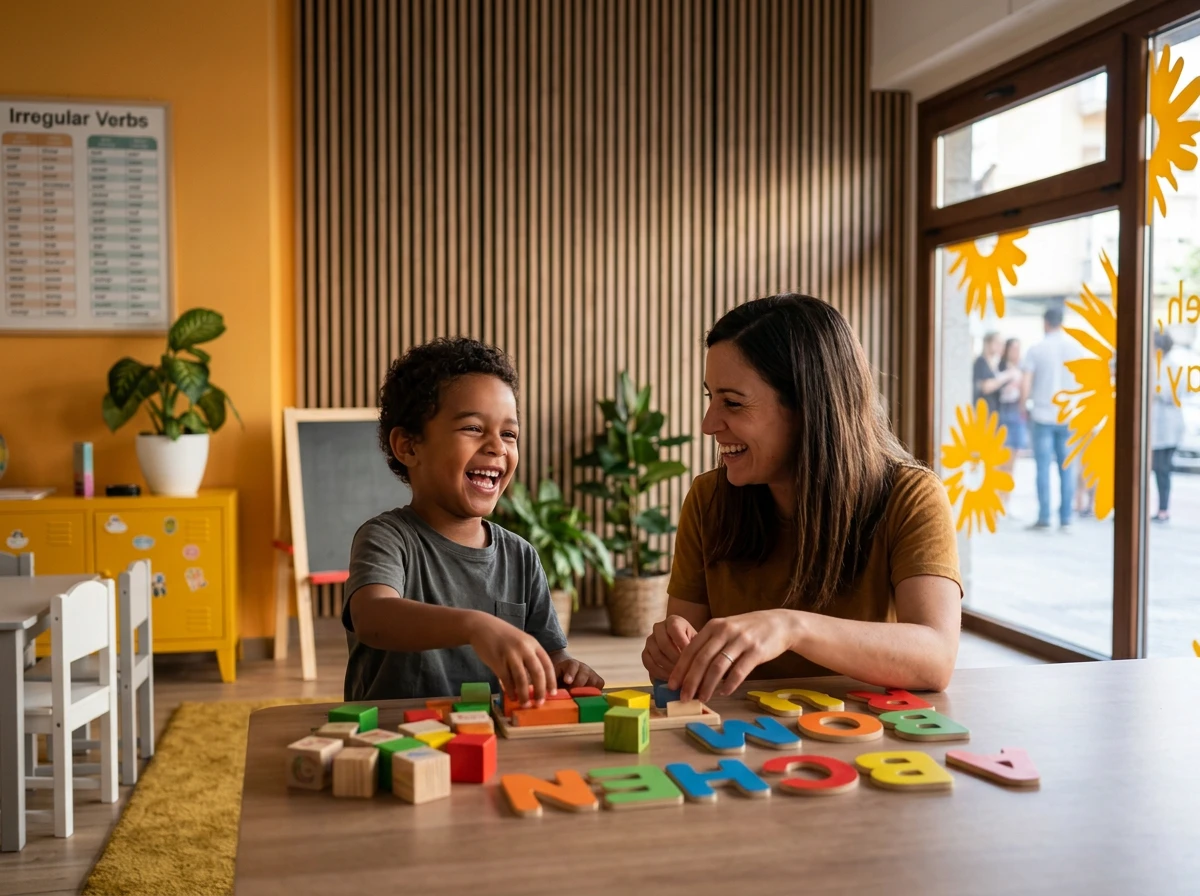
When we teach English, we don’t just work on grammar and vocabulary. We work with sounds, images, real situations, movement, humour, and games that engage the body as well as the mind. Because language is a complete experience, not just a set of rules.
And this goes beyond English. A child learning to type with rhythm and coordination is using their hands, their eyes, their focus, and their muscle memory all at once. An adult learning to use artificial intelligence does better by experimenting with it directly than by having the theory explained on a whiteboard.
Touch, feel, try, fail, correct, try again with enthusiasm. That’s learning with all your senses. And that’s what we do.
Does it work for adults?
Here’s an important point, because many adults think this way of learning “is for children”.
It isn’t. It’s for human brains. And yours is still one, no matter how many years of experience it has.
What does change for adults is the context. You won’t be playing hide-and-seek in English (although you might, one day). But you will practise in situations that mirror your real life: ordering at a restaurant, replying to an email, holding a phone conversation, sorting out a misunderstanding. Situations where you’ll make mistakes, and where those mistakes will teach you more than any fill-in-the-blank exercise.
An adult who walks into class feeling embarrassed and walks out speaking — even with mistakes, even slowly — has learned more in one hour than in months of studying alone with a textbook. Because they’ve experienced the language. They’ve touched it.
What we offer isn’t just a method: it’s a space
Everything we’ve described needs something you can’t buy in a shop or download from an app: a space where making mistakes is safe.
A place where nobody judges you for mispronouncing a word, for not knowing a term, for starting from scratch at forty. A place where the teachers aren’t there to assess you, but to walk alongside you. Where the group doesn’t compete against each other, but moves forward together.
That’s what we try to create in every class. Not just teaching a language, a skill, or a tool. Creating the conditions for learning to become what it always should have been: something natural, something you want to do, something that transforms you without you even realising it.
Something that begins when you stop trying to fit into what you’re “supposed” to know, and simply start being who you are, learning in your own way.
Ser, no encajar. Be, don’t fit in.
Want to discover what learning feels like when the fear of mistakes disappears? At After School, we work with small groups, at your pace, with an approach that trusts you as much as we want you to trust the process. Get in touch and come see for yourself.